WW Chapter 12: The Worlds of the Fifteenth Century
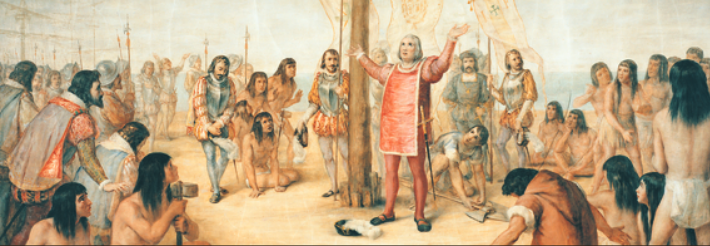
Mural of Columbus by Luigi Gregori (1882-1884)
Covered by the University of Notre Dame in response to Native American Outcry
(Source: https://www.insidehighered.com/news/2019/01/22/university-notre-dame-will-cover-its-murals-christopher-columbus)
Chapter 12: The Worlds of the Fifteenth Century
Expanding Civiliztions
The fifteenth century offers a rich treasury of data on expansion of civilizations westward and elsewhere. While Columbus' voyage opened up the floodgates for European colonization of the Americas, what I found most interesting was elsewhere. China actually had a larger fleet of incredibly huge ships that set off but only made it to Africa's East coast - and the exploration was called off after the biggest proponent, the Chinese emperor Yongle, died. China saw itself as the superior "middle kingdom" needing nothing from outside its borders to thrive, so they saw the expeditions as a waste of money and resource. They recalled the fleet, truly a naval marvel in size and form, and left it rotting in the docks.
Strayer spends some time in what was happening in Mesoamerica with the Aztecs and Incas, as well as in North America with the 5 Iriquois tribes. I found this the most compelling since I wasn't aware of any attempt unification (no matter how loose) of North American tribes. Most of my interest lies with what happened to the Native peoples of Northern California like the Snake, the Pitt, The Klamath and the Modoc - but I'm guessing that the abundant fish and game of the region left little to fight about. I may elect to do my research paper on them if I can dig up enough supporting data.
The 4 expressions of the Islamic Empire were interesting to me, since I was never aware of the Safavid empire in Persia - a Sufi based state that was forcibly coverted to a Shia secular state - or the Songhay in Northern Africa or Mughal empire in India. The Ottoman empire seemed to get all of the press, since it conquered Bizantium and was more of a threat to the West. Since they were all non-secular empires, they did have some sort of unity under the banner of Islam.
Westward Ho
As he is wont to do, Strayer begins the chapter by stirring the pot with respect to Columbus' journey to the Americas. He (quite passive agressively I might add) quotes the president of the Women's Indigenous Network who blames Columbus for ushering in an era of genocide and slavery calling him a "pirate and a thief" (499), and then never returning to the subject again throughout the chapter. Indeed, these things are true, but they are also taken out of context and cultural realativity. Should we cancel Columbus day? He might not be a hero or a pioneer of enlightenment by any stretch of the imagination, but by ignoring the importance of Europe's lasting contribution by taking it off the calendar does nothing to further the discussion. Do we want to simply forget about it and move it to the pages of history texts that no one reads? Erasing history by not recognizing it does not make it go away. It is not justice, nor is it retribution. We should take it in context and learn from history instead of burrying our head in the sand and pretending it never happened. Perhaps Columbus Day is a great time to put history into action and study it for what it is, rather than what it has come to mean to certain identities. More to learn, for sure and I haven't researched it enough to make an unwavering stance, but this is what I take away from it.


Comments
Post a Comment