WW Prologue, Intro, and Chapters 1 and 2
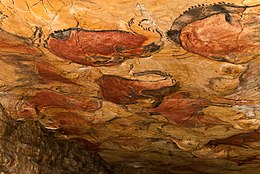
Paleolithic Artwork, Cave of Altimura
(Source: https://it.wikipedia.org/wiki/Grotta_di_Altamira)
(Source: https://it.wikipedia.org/wiki/Grotta_di_Altamira)
Joseph Randall Cali
Patti Andrews
World History HST 2020-01
9 May 2019
WW Prologue, Intro, and Chapters 1 and 2
"Big History", the Paleolithic and the Neolithic Ages
Strayer's text begins with a discussion of "Big History", the study of history that includes the Paleolithic and Neolithic periods occurring before the written word. Although I find them fascinating, Strayer contends that these periods have been ignored by history professors for a couple of reasons. I would agree that first of all, they are pre-historical, occurring before history was written. Without a written account, the events of these early periods are largely reconstructed via relics and artifacts. Because of this, these periods were the domain of arciologists and anthropologists rather than historians. Secondly, history is the study of change over time. We can focus on events, but it's the change over time that provides the context to those events. The amount of change that took place in the early stages of history wasn't much (although profound) and it was extremely slow - taking up a span of around 250,000 years.
I found that the change that did take place, however, was monumental, changing the course of our story on this planet. The Paleolithic period occupied a whopping 95% of our time here. Known as the Old Stone Age, it is defined by the rise of Homo Sapiens (a MAJOR development), the development of primitive stone tools, the organization of humanity into small social gatherer/hunter groups and, ultimately, the migration of those groups out of Africa (another MAJOR development) and into Europe and Asia. Worthwhile study for any student of history that would like to know how ancient civilizations came to be in the first place.
This migration was prompted by the environmental conditions at the time - namely the ice age. As the glacial regions iced over, the sea levels dropped, exposing land bridges where none had existed. Nomadic Paleolithic peoples, following the large animals they depended on for their diets and seeking more hospitible climes, eventually disbursed throughout the European and Asian continents.
The end of the ice age coincided with the mass extinction of the large animals (mammoths and other large game) that they hunted, giving way to smaller game such as bison. The warmer climate also led to new grains and plants that thrived. The smaller game was easier to domesticate and the more tollerable climate was condusive to building permanent settlements. Here's where things begin to get interesting for me.
The Neolithic period, also called the New Stone Age, is synonomous with the Agricultural Revolution and is characterized by the singular changes that occured turning the nomadic Paleolithic gatherer/hunters into settled farmers and herders. Permanent settlements paved the way for organized society, specialized skills, organized religion and the ability to store and accumulate wealth. Naturally, the human population began to grow rapidly requiring more food to support it. New technologies for growing food were quickly developed leading to more prosperity and a speedy cycle of innovation.
Paleolithic, Neolithic, Ancient, Classical, Modern - So... What in blazes makes an "Age" an "Age" anyhow?
My grasp on the concept of periodization - grouping the 5 historical ages into categories - is much improved after reading the first couple chapters of the text. My real question was, "What makes a seemingly arbitrary construct like an 'age' begin and end ?" It seems simple enough, but I wanted move beyond rote memorization and understand the "rule" (for lack of a better term) that governed these periods. The way I view historical periods now is that each category (period or age) has a set of attributes that define it. When one or more of those attributes significantly changes enough to the point that it no longer fits the category - a new category is needed. In the case of the Paleolithic age, nomadic gatherer/hunters ceased their wandering ways enough to build permanent settlements and farm - the agricultural revolution was born. So was the Neolithic period. History is indeed all about change.
The Slow Rise of Civilization
As the Agricultural Revolution took shape, some groups, lacking the animals to domesticate, relied more on farming than on pastoral herding. These groups were more likely to build permanent settlements, while the more nomadic herding groups stayed relatively mobile. These more permanent settlements were quick to organize themselves and technology brought rapid advances.
Of particular importance to me was that the ability to accumulate wealth and specialization of skills began to lead to the origins of social inequity. Gender roles became more defined as everyone specialized and the mobility of the group was not as important. I found it a little confusing with respect to the text's definition of gender, however. Strayer refers to gender as the association of a defined role to a sex. I initially believed that he was using the construct as a foundational term to incorporate social justice elements into his writing, and found it confusing and "manufactured" (IE It felt more like journalistic license than grounded science). After looking around on the web I was enlightened to find that gender can be defined as reference to social or cultural differences rather than biological ones. Good to know!
These permanent settlements led to organized governance, water delivery technology, food production on a large scale, rapid and sustained population growth, and ultimately, the great human civilizations to come.
The Slow Rise of Civilization
As the Agricultural Revolution took shape, some groups, lacking the animals to domesticate, relied more on farming than on pastoral herding. These groups were more likely to build permanent settlements, while the more nomadic herding groups stayed relatively mobile. These more permanent settlements were quick to organize themselves and technology brought rapid advances.
Of particular importance to me was that the ability to accumulate wealth and specialization of skills began to lead to the origins of social inequity. Gender roles became more defined as everyone specialized and the mobility of the group was not as important. I found it a little confusing with respect to the text's definition of gender, however. Strayer refers to gender as the association of a defined role to a sex. I initially believed that he was using the construct as a foundational term to incorporate social justice elements into his writing, and found it confusing and "manufactured" (IE It felt more like journalistic license than grounded science). After looking around on the web I was enlightened to find that gender can be defined as reference to social or cultural differences rather than biological ones. Good to know!
These permanent settlements led to organized governance, water delivery technology, food production on a large scale, rapid and sustained population growth, and ultimately, the great human civilizations to come.


Comments
Post a Comment