WW Chapter 3: State and Empire in Eurasia/North Africa
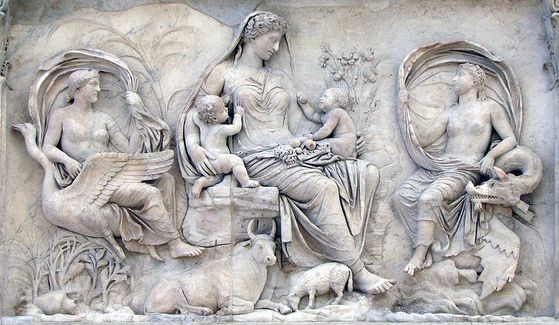 |
Roman Artwork Depicting a Woman Caring for Her Children
(Source: https://www.arcgis.com/apps/MapJournal/index.html?appid=18277b7bfb394c48b77e6308a09259fc)
(Source: https://www.arcgis.com/apps/MapJournal/index.html?appid=18277b7bfb394c48b77e6308a09259fc)
Joseph Randall Cali
Patti Andrews
World History HST 2020-01
16 May 2019
WW Intro to Part 2, Chapter 3
500 BCE to 500 CE
The evolution of the Neolithic Period into the Ancient Period around 500 BCE is characterized by the rise of a second wave of civilizations - or Empires, writing and political systems. Great civilizations like the Persian, Greek, Roman and Chinese empires rose up and began to flourish in a short time span when compared to the prior periods. The rapid changes in agricultural methods and technology advancements forever changed the path of human development.
I find the period of the early ancient civilizations of special interest to me. In a relatively short time period, the influences of culture and art of the great civilizations of the world - Persia, Greece, Rome and China were born, flourished, expanded and, ultimately, colapsed. Their influences continue today in our political systems, phillosophy and artistic expression.
What About the Persians and the Greeks? Hint: All Roads Lead to Rome.
The Persian empire encompassed the Caucasus Mountains in the North and South to Babylonia and Egypt, from Afgahnistan in the East to Macedonia in the West. The population was North of 35 million people. Its expansion was the result of conquests by Cyrus the Great and Darius (108). The empire was ruled by Monarchs that claimed their legitimacy by association with the sacred. The kings were the chosen rulers of the god Ahura Mazda and rulled with complete power. Supplementing the absolute power of the king, governors were were installed in the provinces of Persia and a hierarchy of officials matriculated from there. An important policy of the Persian empire was to maintain respect for the cultures of conquered lands and keep them intact. This helped maintain stability. The Persians were noted for great technology and political advancements including (perhaps not so great) beuracracy, taxes, standardized coinage and improved transportation. They are even credited with the creation of the postal service.
The Greek empire, on the other hand, was made up of small competing city states and allowed public participation in the affairs that governed society. The empire was comprised of a small population compared to that of the Persians, only about 3 million. The political shape of the country was influenced by the geography of the area, which consisted of mountains and the sea. One of the biggest differences between the Persians and Greeks was that the Greek empire had a unified culture, worshiping the same gods and speaking the same language. The Greeks expanded through settlement rather than conquest, which I believe was key to maintaining a single culture and later defending their holdings against the Persian onslaughts. Inequality in Greece was expressed in the fact that only those with full citizenship could vote and hold office, and only those that could afford to fight in the army could get full citizenship. This excluded women and slaves.
Strayer contends that the Greeks actually looked to the East (Egypt and the Persian Empire) for cultural and technological inspiration. As the Persians expanded their holdings westward in Anatolia, Greek settlements were consumed. Finding support from Athens, they beat back the Persians. This action emboldened Athens, and nationalism was at an all time high. Athens later attempted to assert its dominance battling Sparta in the Peloponnesian war, but Athens was defeated. The Greek empire was weakened and Macedonia took over Greece, led by its king, Phillip II. Under Phillip the Greek city states were unified. A newly unified greece followed Phillips son, Alexander, into a retributive attack on Persian empire. Alexander defeated the great empire claiming all the lands from India through Macedonia, and diseminating greek culture in what is known as the Helnistic era. Eventually, Roman expansion ended up dominating the greek empire and the two great cultures intermingled, becoming a part of the rapdily growing Roman republic, ultimately, the ill fated Roman Empire.
So, What happend to the Great Roman and Chinese Civilizations?
What I find most interesting is what became of some of these civilizations after their colapse. The empire of China actually rebooted itself succesfully under the Sui, Tang and Song dynasties perssting from 589 C.E. into the twentieth century. The Roman empire was conquered by the Germanic kingdoms with their own identities, languages and technologies. Why was China able to rise again in its prior image while Rome disolved into what would become distinctly separate kindoms throughout Europe? The answer is a complex one, but Strayer offers several possible reasons for this.
China's singular culture and ethinicty made it easier to reestablish a new empire. Their beuracracy, based on Confucianism, was a successful secular political strategy since it centered on duty and role. China's more advanced metalurgy technology and more productive agriculture gave the new empire more to draw on. Language was likely a major component as well. Since the Chinese alphabet depicts phrases and words, the written word is not transferable easily to other languages. The educated classes that could read maintained the homogeneous cultural identy of China.
The Roman empire, on the other hand, had a powerful non-secular component - the Catholic Church - which was frequently in a power struggle with Rome's political coponent, did little to support a new empire since they could excersize control in their own city states within the realm. The Latin alphabet was based on sounds, so it was easily tranferred to multiple languages, allowing the educated elite to maintain their own identities and cultures. This was more conducive to building new soveriegn states. Not all was forgotten, however - The Roman republic became a blueprint for future democracies to come.


Comments
Post a Comment