WW Chapter 10: The Worlds of Christendom
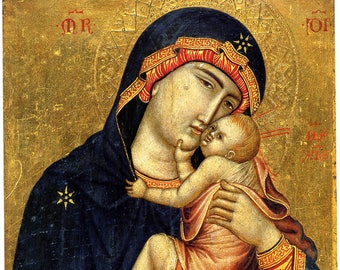
The Cambrai Madonna - Byzantine c.a. 1340
(Source: https://wikivisually.com/wiki/Cambrai_Madonna)
Chapter 10: The Worlds of Christendom
Constraction, Expansion and Division
500 - 1300
Remebering to Forget
"Usualy students of history are asked to remember. But forgetting can also be an aid to historical understanding" (Strayer 446). This quote by Strayer, found at the end of chapter 10, is probably the most enlightening thing I've read thus far. By forgetting what you think you already know about history, you can reexamine it through a fresh perspective - your own, intstead of what some one else has decided what its relevance is.
Oddly enough, I think that this chapter offered me some great insights after thinking about this quote. My wife is Armenian Orthodox (by way of Buenos Aires, her grandparents moved there post genocide), and I am Roman Catholic (by way of Sicily). I am extremly familiar with both traditions now, but the fascination for me was illuminated in this chapter with a greater understanding of the differences and similarities of the Othodox Christian faith of the Byzantine Empire and the Roman Catholic faith in the civilizations of Western Europe. We share similar traditions, saints and holidays (although two major ones, Easter and Christmas are observed on different days).
One of the biggest differences I noticed was that the Western - Roman Catholic - empire separated the power of the rulers and the head of the church, to the point of letting the church appoint its own pope. On the other hand, The Orthodox states accepted christianity as a state religion (Armenia and Axum in the 4th Century) where the rulers legitimized their authority via association with the sacred, In Constantinople the emporer went as far as referring to himself as "God's wordly representative" (417). The Orthodox Christian empire had similarities with the nation of Islam in that respect - both were non-secular. In fact, they shared many touchstones, one of which was respect for the Greek philosophers and learning.
Initially, the Byzantine state, headquartered in Constantinople was a highly evolved, wealthy and cosmopolitan state with a rapidly growing population of converts. Due to the proximity of Byzantium to the important trade routes, the empire flourished, until the Ottoman Turks finally got a hold of it in 1453 (and wiped out over a million Christian Armenians in 1915, but thats a different story). In the west, the religion was more centralized with the pope at its head and the religion dispersed throughout the western European city states. All of these with their own languages and cultures. This led to a slow growing adoption of the religion. This was all new information to me, since I had always thought that Christianity's split set off two seaparate versions of the religion on an equal trajectory.
Another new bit of information I learned was that the spread of Christianity was sucessful in both Asia and Africa for several hundred years before finally contracting. The influence of religion and the tendancy for it to grow and decline in certain areas is interesting to me. Almost like a breathing entity, inhaling and exhaling.


Comments
Post a Comment